
IPTV for Sports Fans in the United States: Stream Live Football Without Wrecking Your Budget
If you're a member of a credit union, you already know the first rule of personal finance: every recurring subscription you don't audit is money quietly leaving your account. And for most American households, the single biggest line item on that list is the cable or satellite bill — often $90 to $150 a month, with a large chunk of it paying for hundreds of channels nobody in the house actually watches.
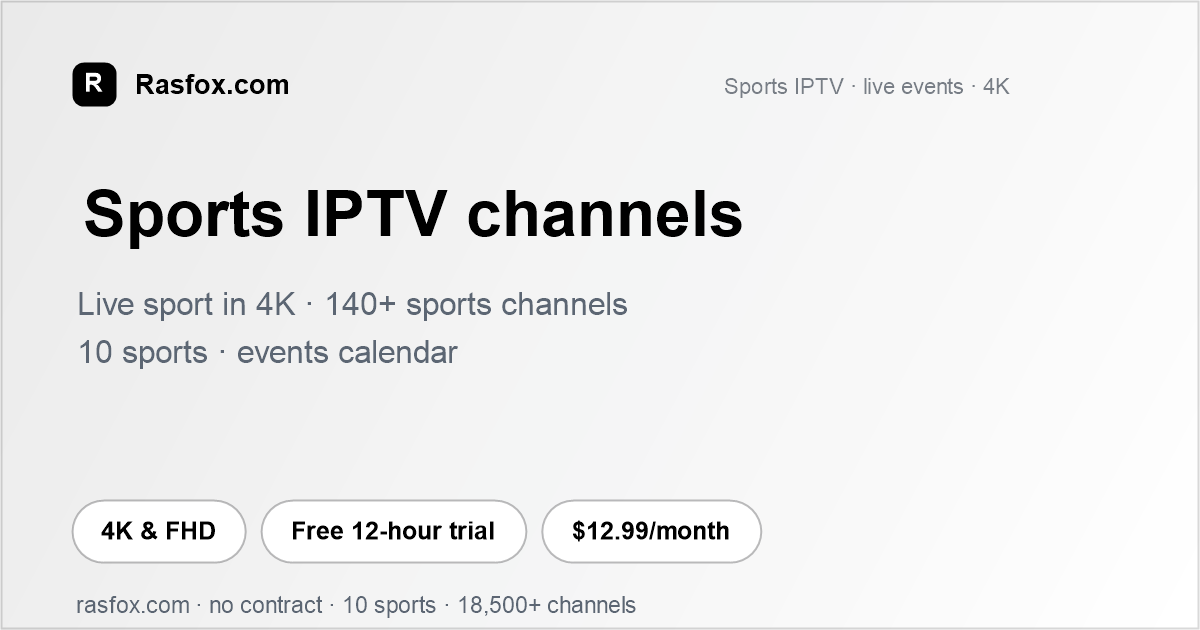
But here's the tension every sports fan knows: the moment you try to cut cable, the first thing you lose is the football. No more Champions League midweek nights, no more Brasileirão on a Saturday afternoon, no more Premier League or La Liga on the weekend. So the question becomes a financial one — can you keep the sports you love while spending less than you do today?
That's exactly where IPTV comes in, and it's the reason this article exists. Think of it as a budgeting guide with a sports section attached: how modern IPTV works, what it really costs, how it compares to the cable contract you're probably stuck in, and how a sports-first provider like RasFox IPTV fits into a genuinely smart household budget.
What Is IPTV, and Why Does It Matter for Live Sports?
IPTV stands for Internet Protocol Television. Instead of receiving channels through a coax cable, a satellite dish, or a legacy set-top box, IPTV delivers live TV channels and on-demand content over your regular internet connection — the same broadband you already pay for.
In practice, that changes three things:
- No hardware lock-in. You don't need a dish on the roof or a technician appointment. A streaming stick, a smart TV, a tablet, or even your phone is enough.
- No long-term contract. Reputable IPTV services are prepaid and month-to-month, which means no early-termination fees and no two-year price lock that quietly doubles in month thirteen.
- Channel choice that matches your life. If you're a sports fan, you don't need 400 shopping and lifestyle channels. You need the leagues and competitions you actually watch — and IPTV lineups are built around exactly that.
IPTV vs. Traditional Cable and Satellite
Traditional providers bundle the good with the filler. To get the sports tier, you usually have to buy the base package first, then add the sports package, then add the regional sports fee, then the equipment rental, then the broadcast fee. By the time you're done, the advertised price and the real price are two very different numbers.
IPTV flips that model. You buy one service, you get the full channel list, and there are no equipment rentals. That's the entire financial argument in one sentence.
The Sports-First Difference
Not all IPTV providers are built the same way. Some are general entertainment catalogues with a few sports channels bolted on. That's fine until a big match kicks off and the stream starts stuttering at the worst possible moment.
A sports-first service is engineered around peak load: match nights, derbies, knockout rounds, Formula 1 race weekends, UFC pay-per-view cards. That means more server capacity, better routing, and streams that don't buffer when everybody else is watching the same game you are.
The Smart Money Angle: How IPTV Fits Into a Real Household Budget
Credit union members tend to be practical people. You don't need a lecture on compound interest to recognize a good deal — you just want the numbers to make sense. So let's look at it the way a budgeting worksheet would.
Say your household currently pays $120 a month for cable with a sports tier. Over twelve months, that's $1,440. Add a streaming service or two for the family, and you're easily past $1,700 a year on screen time alone.
Now consider what that same budget looks like when it's redirected:
- Lower monthly spend. IPTV packages are a fraction of a traditional cable bill, and there's no equipment rental stacked on top.
- No contract risk. Month-to-month means you can stop whenever you want — no cancellation phone call, no retention department, no fee.
- No duplicate subscriptions. When one service covers live sports, news, movies, and series for the entire household, you can retire the extra apps you're paying for separately.
- The savings compound. Redirect even $60 a month into a savings account or a share certificate and you've built a real emergency cushion out of money you were already spending on television.
That last point matters. Most financial counselors suggest starting with the subscriptions you already have rather than trying to squeeze new money out of nowhere — because the fastest budget win is the bill you're already paying. Television is one of the few recurring costs where switching providers can cut the number by more than half without giving up anything you actually watch.
If you want to test the numbers before committing to anything, the best IPTV service for live sports on the market right now lets you run a full 24-hour free trial — which means you can compare picture quality, channel coverage, and buffering performance on your own internet connection before a single dollar leaves your account.
Built for Sports: Inside the RasFox.com Channel Lineup
RasFox.com didn't start as a generic streaming platform. Its roots go back to Radio Malena 89.1 FM in Buenos Aires (Venezuela 370) — a station steeped in tango and Argentine broadcasting culture. That background matters, because it explains the DNA of the service: it was built by people who care about live events, live audio, and the feeling of watching something as it happens, not on demand three days later.
Today that same philosophy powers an IPTV service aimed at lusophone and Latino communities worldwide, with a lineup that leans hard into sport. The headline numbers:
- 12,000+ live channels across sports, news, entertainment, and kids' programming
- 40,000+ VOD titles in 4K at 50 frames per second — smooth, broadcast-quality motion for fast-moving sports
- Two simultaneous screens per subscription, so one household isn't fighting over the remote
- Anti-buffering infrastructure designed for match-night traffic spikes
- No contract, no lock-in — prepaid and cancel-anytime
- 24-hour free trial so you can verify performance before paying
- Support in Portuguese and Spanish — a real advantage for bilingual and immigrant households
For football specifically, the coverage spans the competitions that actually drive subscriptions: Brasileirão, Copa Libertadores, the Champions League, Liga Portugal, Liga Argentina, La Liga, the Premier League, plus Formula 1 and UFC fight cards.
Channel-wise, the lineup covers global sports broadcasters like ESPN, DAZN, Fox Sports, beIN Sports, Sky Sports, and Eurosport, alongside regional heavyweights. Brazilian viewers get Globo, SporTV, Premiere, ESPN Brasil, BandSports, Combate, and TNT Sports BR. Portuguese fans get Sport TV 1–6, Eleven Sports, Benfica TV, Porto Canal, DAZN Portugal, and Eurosport. Argentine and wider Latino audiences get TyC Sports, ESPN Premium, TNT Sports Argentina, Fox Sports, and DirecTV Sports. African subscribers get SuperSport, Sport TV Africa, and ESPN Africa.
For a household in the United States, that breadth is the real value: you're not choosing between American sports coverage and the football you grew up with. You get both, on one subscription.
Deep Dive: The IPTV Landscape in the United States
The United States is, in many ways, the ideal market for internet-based television — and simultaneously one of the most expensive places to watch sports the traditional way.
Broadband penetration is high, fiber and cable internet are widely available, and average connection speeds in most metro areas comfortably exceed the 25 Mbps needed for a stable 4K stream. Meanwhile, the average cable bill keeps climbing, regional sports network fees keep inflating, and blackout rules still leave fans unable to watch their own local teams on the service they're already paying for.
That combination — great internet, terrible cable economics — is exactly why IPTV adoption has grown so quickly among American households, and especially among immigrant and bilingual families who want channels from home alongside U.S. coverage.
What Makes the U.S. Market Different
- Diaspora demand. The U.S. is home to large Brazilian, Argentine, Portuguese, Mexican, and Colombian communities. Households want both ESPN and SporTV, both Fox Sports and TyC Sports.
- Sports fragmentation. Following a single league can require three or four separate subscriptions. IPTV consolidates that into one bill.
- No-contract culture. American consumers have moved decisively toward month-to-month streaming. IPTV already works that way by default.
- Multi-device households. Phones, tablets, smart TVs, and laptops all need to work. A two-screen IPTV plan handles the practical reality of a family home.
Practical Considerations Before You Switch
Two things are worth checking before you cancel anything. First, your internet speed — run a test during peak evening hours, not at 10 a.m. on a Tuesday. Second, your home network: if your router is five years old and sits in a closet, a mesh node or a simple Ethernet run to your streaming device will do more for stream stability than any provider upgrade.
Hardware and Setup: What You Actually Need
One of the quiet advantages of IPTV from a budgeting perspective is that you probably already own everything required. There's no dish, no installer visit, and no rental box adding $10 to $15 a month to your bill forever.
Here's a realistic setup list:
- Streaming device: Amazon Fire TV Stick, Android TV box, Chromecast, or Apple TV
- Or a smart TV: most modern Samsung, LG, Sony, and TCL sets run IPTV apps natively
- Or just a phone, tablet, or laptop — ideal for watching a match on a second screen
- Internet: 15–25 Mbps per stream for reliable HD and 4K playback
- Wired connection or strong Wi-Fi: the single biggest factor in eliminating buffering
Setup itself takes minutes, not days. You install the app, enter your credentials, and let the channel list populate. No technician, no appointment window, no drilling holes in your wall.
Because there's no contract involved, the sensible approach is to start with a free IPTV trial on the exact device you plan to use — Fire Stick, smart TV, whatever it is — and watch a live match during peak hours. If it holds up, you've validated the setup before paying. If it doesn't, you've lost nothing but an evening.
Legal vs. Illegal IPTV: Protecting Your Wallet and Your Data
This is the section most IPTV articles skip, and it's the one that matters most for anyone who thinks like a credit union member: unlicensed services are a financial risk, not just a legal one.
The IPTV technology itself is completely legitimate. Major telecom companies, broadcasters, and streaming platforms all use IPTV infrastructure. What separates a legal service from an illegal one is licensing and content rights.
Red flags to watch for:
- Prices that are implausibly low — a few dollars for "every channel in the world"
- No identifiable company, address, or support channel
- Payment accepted only through untraceable methods
- No terms of service, no refund policy, no privacy documentation
- Aggressive pop-ups or sketchy third-party app stores required for installation
The risks go beyond legal exposure. Unlicensed providers can vanish overnight with your prepayment. They may bundle malware with their apps. And because they operate outside consumer protection frameworks, there's no chargeback path and no regulator to complain to.
A safer approach is to choose a service with a real identity, real support, and a transparent trial — which is precisely how RasFox.com's IPTV platform is structured. The service traces back to a legitimate broadcasting heritage in Radio Malena 89.1 FM in Buenos Aires, offers documented 24-hour free trials, provides Portuguese- and Spanish-language support, and operates on a prepaid model that doesn't require you to hand over contract-level commitments.
For any household, the rule is straightforward: if a deal looks too good to be true and hides who's behind it, treat it the same way you'd treat a suspicious email claiming to be your bank.
Frequently Asked Questions
How much does IPTV cost compared to cable in the United States?
IPTV subscriptions typically cost a fraction of a traditional cable or satellite package, and there are no equipment rental fees or long-term contracts. Most households find the savings come from eliminating both the inflated base package and the add-on sports tier they were forced to buy.
Can I watch live football and Champions League games on IPTV?
Yes. Sports-focused IPTV services carry dedicated channels for competitions including the Champions League, Premier League, La Liga, Brasileirão, Copa Libertadores, Liga Portugal, and Liga Argentina, along with Formula 1 and UFC events.
Do I need fast internet for IPTV?
A stable connection of 15–25 Mbps per stream is generally enough for HD and 4K playback. Stability matters more than raw speed — a wired Ethernet connection or a good mesh Wi-Fi setup will do more for you than upgrading to a faster plan.
Is IPTV legal?
The technology is entirely legal and widely used by mainstream broadcasters. Legality depends on whether the service holds proper content licensing. Choosing a provider with a verifiable identity, published terms, and legitimate support is the safest path.
Can I try IPTV before subscribing?
Yes. Reputable providers offer a free trial — RasFox.com offers a full 24-hour trial, which lets you test picture quality and stability on your own network before paying anything.
How many devices can I use at once?
RasFox.com includes two simultaneous screens, which covers most households — one for the live match, one for everything else.
The Bottom Line: Watch More Sport, Spend Less Money
If you take one idea from this article, make it this: the fastest way to improve your household budget isn't earning more — it's auditing what you already pay. And for most families, the television bill is the biggest, most renegotiable expense on the list.
IPTV gives you a way out of the cable contract without giving up the football. The right service combines a sports-first channel lineup, 4K 50FPS picture quality, no buffering on match nights, two screens, no contract, and support in the languages you actually speak — all for a fraction of what a traditional provider charges.
Start with the free 24-hour trial from RasFox IPTV. Watch a live match on your own connection, on your own device. If it performs the way it should, you've just found a permanent line-item reduction in your monthly budget — and a much better way to watch the game.